

There is a specific silence that belongs only to hot megacities.
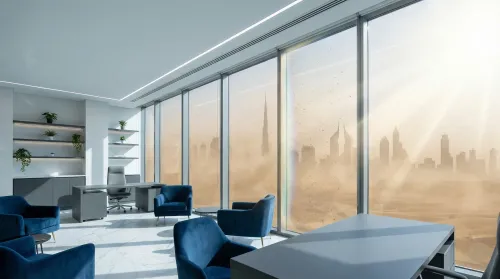
At noon in Dubai in August, the city seems almost suspended. Roads shimmer under thermal distortion. Towers reflect solar radiation like mirrors. The air is still — not empty, but heavy. It holds heat, dust, moisture, pollutants, and the metabolic output of millions of people and machines.
This is not merely a weather condition. It is a systemic atmospheric state.
In regions such as the Arabian Gulf, environmental physics, urban density, and extreme climate interact in ways that fundamentally reshape how air behaves — outdoors and indoors. To live and work here means to inhabit an engineered microclimate inside buildings that must actively resist external conditions.
Understanding this environment is not only a matter of comfort. It is a matter of human performance, health stability, and long-term resilience.
1. Heat as an Atmospheric Force
The Gulf region is one of the most thermally extreme urbanized environments on Earth. Summer temperatures routinely exceed 45°C. Relative humidity in coastal cities can rise above 80%. Solar radiation intensity is among the highest globally.
According to the International Energy Agency (IEA), cooling demand in hot climates can represent more than 60% of peak electricity load during summer months. In the UAE specifically, cooling dominates urban energy consumption.
Extreme heat does more than increase temperature. It alters atmospheric circulation.
High-pressure heat domes suppress vertical mixing. Air stagnates. Wind speeds decline. Pollutants accumulate. Dust remains suspended longer. Atmospheric renewal becomes episodic rather than continuous.
The National Oceanic and Atmospheric Administration (NOAA) has documented how heat domes reduce convective exchange and create stable air layers that trap contaminants near the surface.
In such systems, cities function temporarily like semi-closed atmospheric chambers.
2. Dust Storms: A Seasonal Atmospheric Event
Dust storms in the Gulf are not anomalies; they are structural features of the regional climate.
Driven primarily by the shamal wind system, dust events originate from desert surfaces in Iraq, Saudi Arabia, and surrounding arid zones. Limited vegetation cover and soil dryness increase particle mobilization.
NASA Earth Observatory has repeatedly analyzed Middle Eastern dust transport, showing how particulate matter travels across the Gulf basin, affecting urban centers including Dubai and Doha.
During these events, PM10 concentrations can exceed WHO safe thresholds multiple times over. Fine particulate matter (PM2.5) penetrates deep into the respiratory system and has been linked to increased cardiovascular and respiratory risk (WHO Global Air Quality Guidelines, 2021).
But dust does not simply disappear once it enters a city.
Urban canyons — high-rise corridors — slow horizontal air movement. Heat island effects intensify vertical stagnation. Buildings become filters by necessity.
3. Oxygen: The Invisible Constant That Is Not Constant
Atmospheric oxygen globally averages about 20.9% by volume. This value is often treated as immutable in building engineering.
Modern HVAC design, including standards such as ASHRAE 62.1, focuses on ventilation rates, CO₂ concentration, humidity, and contaminant removal. Oxygen is assumed to remain sufficient if ventilation meets minimum requirements.
Historically, this assumption made sense in temperate climates with strong atmospheric mixing.
In hot megacities, the assumption deserves closer examination.
Urban metabolism research introduces the concept of oxygen balance within cities. Wei et al. (MDPI Atmosphere, 2022) describe the Oxygen Index (OI), a ratio between oxygen consumption and oxygen production in a defined urban system.
Cities with high fossil fuel consumption, intensive cooling demand, dense traffic, and limited vegetation exhibit elevated oxygen consumption relative to local biological production.
While atmospheric exchange with surrounding regions maintains global oxygen equilibrium, localized micro-variations can occur, especially during stagnation events.
Measurements in high-density urban areas during extreme heat episodes have recorded slight reductions in near-surface oxygen concentration, sometimes within the range of 19.6–19.9%.
Numerically small, physiologically meaningful.
4. The Biology of Oxygen: Beyond Survival
Oxygen is not merely a life-or-death variable.
It defines metabolic efficiency.
At the cellular level, oxygen enables oxidative phosphorylation inside mitochondria — the primary mechanism by which ATP, the body’s energy currency, is produced.
The human brain consumes roughly 20% of total oxygen intake despite representing only about 2% of body mass.
Research in environmental physiology demonstrates that even mild reductions in oxygen availability — well above hypoxia thresholds — can:
Increase perceived mental effort
Reduce executive cognitive function
Slow reaction time
Elevate stress response markers
Increase fatigue
Studies from Harvard T.H. Chan School of Public Health have linked indoor air quality parameters to cognitive performance in controlled office environments. While much of this research focuses on CO₂ levels, oxygen availability operates on the same physiological axis: cerebral metabolism.
Under thermal stress — common in Gulf climates — oxygen demand increases. Heat exposure elevates cardiovascular load and sympathetic nervous system activation (National Institute for Occupational Safety and Health, NIOSH).
Thus, heat, air stagnation, and oxygen dynamics intersect biologically.
5. Seasonal Air Quality in Dubai
The Gulf exhibits strong seasonal asymmetry.
Summer
Extreme heat
Atmospheric stagnation
High ozone formation potential
Continuous cooling operation
Limited natural ventilation
Winter
Improved wind circulation
Lower energy demand
Greater atmospheric mixing
Reduced stagnation
Spring
Peak dust transport
Elevated particulate matter
Autumn
Transitional stabilization
These seasonal cycles influence indoor air indirectly.
Buildings in summer operate in sealed mode. Air recirculation dominates. Fresh air intake is minimized to preserve cooling efficiency.
In winter, natural atmospheric mixing supports better outdoor air dispersion, indirectly improving baseline intake conditions.
The United States Environmental Protection Agency (EPA) and WHO both emphasize that indoor air quality depends heavily on outdoor air conditions — especially in mechanically ventilated buildings.
6. The Indoor Paradox of the Gulf
The Arabian Gulf contains some of the most climate-controlled urban interiors on Earth.
Air-conditioned offices, malls, residential towers, hotels — entire cities operate within sealed thermal envelopes.
Temperature and humidity are controlled precisely.
Oxygen is not.
Traditional HVAC systems are optimized for:
Thermal comfort
Humidity balance
CO₂ dilution
Filtration of particulates
But oxygen concentration is rarely monitored directly.
This creates a paradox: in one of the most engineered climates in the world, the primary metabolic resource for human cognition remains largely unmanaged.
7. Air, Productivity, and Economic Value
In commercial office environments, labor costs exceed energy costs by orders of magnitude.
Small changes in cognitive efficiency have disproportionate economic implications.
Research in occupational health demonstrates that air quality affects:
Decision-making speed
Error rates
Problem-solving capacity
Fatigue accumulation
In knowledge-based economies — finance, technology, strategy, creative industries — these variables are economically measurable.
As buildings become smarter in terms of energy and carbon management, human performance conditions emerge as the next frontier.
Indoor environmental stability is no longer only about comfort; it is about economic optimization.
8. Climate Literacy and Conscious Living
There is a growing need for climate literacy in hot megacities.
Understanding that:
Dust storms are seasonal atmospheric phenomena
Heat domes alter air circulation
Oxygen production depends heavily on marine phytoplankton (NOAA estimates over 50% of global oxygen originates from oceanic photosynthesis)
Urban vegetation contributes but is not the sole oxygen source
Dispelling myths — such as “trees alone are the lungs of the planet” — is part of responsible environmental awareness. Oceanic microorganisms, particularly phytoplankton, are the dominant oxygen producers globally (NOAA Ocean Service).
Oxygen is abundant globally, but locally shaped.
And locally experienced.
9. Module21 and Environmental Stabilization
In extreme climates, ideal indoor conditions do not happen passively.
They are engineered.
Module21 approaches indoor air as a dynamic environmental system rather than a static compliance variable. In regions where:
Heat stress is chronic
Dust events are seasonal
Energy demand is extreme
Air stagnation is structural
Stability becomes the key objective.
Creating interior environments that support metabolic efficiency, cognitive clarity, and respiratory balance is not luxury.
It is environmental adaptation.
In the Gulf region, the future of real estate, offices, and urban living will increasingly depend on how well buildings manage not just temperature and humidity — but the full spectrum of atmospheric stability.
Air is not background.
It is infrastructure.
Breathe Better. Live Better. Experience Oxyness.
Sources
World Health Organization. Global Air Quality Guidelines, 2021
https://www.who.int
NASA Earth Observatory. Middle East Dust Transport Studies
https://earthobservatory.nasa.gov
NOAA. Heat Domes and Atmospheric Circulation
https://www.noaa.gov
NOAA Ocean Service. How Much Oxygen Comes from the Ocean
https://oceanservice.noaa.gov
Wei, Y. et al. Urban Oxygen Balance and Oxygen Index. MDPI Atmosphere, 2022
https://www.mdpi.com
International Energy Agency. The Future of Cooling
https://www.iea.org
U.S. Environmental Protection Agency. Indoor Air Quality Research
https://www.epa.gov
ASHRAE Standard 62.1. Ventilation for Acceptable Indoor Air Quality
https://www.ashrae.org
NIOSH. Heat Stress and Worker Health
https://www.cdc.gov/niosh
Harvard T.H. Chan School of Public Health. Indoor Air and Cognitive Function
https://www.hsph.harvard.edu

Module21 for Your Business

Module21 for Your home