
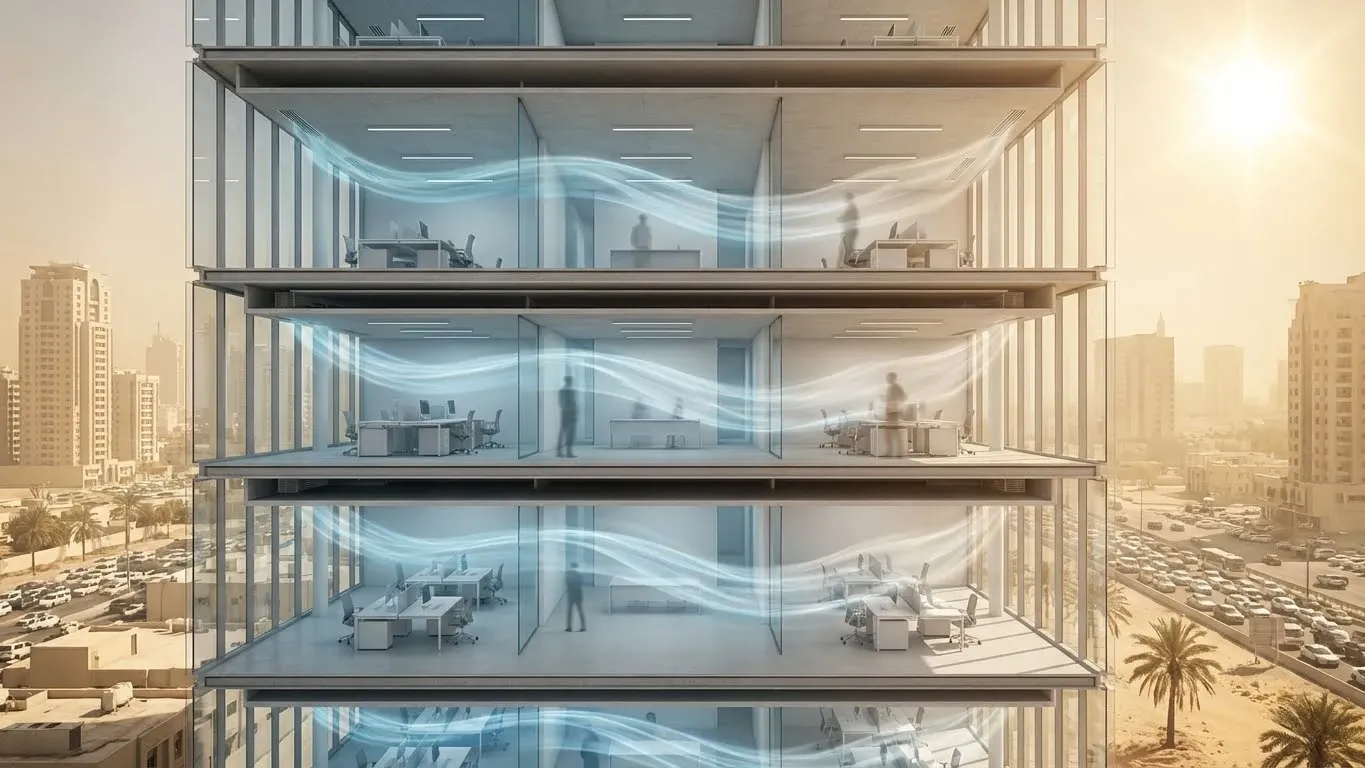
Why Indoor Air Quality (IAQ) becomes a critical system in hot and dense urban environments
For decades, the engineering value of a building has been defined by a familiar set of systems: electricity, water supply, heating and cooling, ventilation, and lighting. These systems are carefully designed, regulated, commissioned, and audited. They influence construction cost, operating expenses, tenant satisfaction, and ultimately the market value of the asset.
Indoor Air Quality (IAQ), despite its direct impact on human health and performance, has long been treated as a secondary outcome of ventilation rather than as an independent engineering discipline. In many projects, air quality is assumed to be “acceptable” once ventilation rates meet minimum regulatory requirements.
In hot climates and dense urban environments, this assumption is increasingly inadequate. Air inside buildings is no longer a neutral background condition. It becomes a strategic engineering factor that affects energy consumption, operational stability, occupant wellbeing, and investment risk.
What Indoor Air Quality actually means
Indoor Air Quality (IAQ) is a formal technical term used in international building standards, occupational health regulations, and scientific research. It describes the condition of indoor air based on a set of measurable physical and chemical parameters, including:
outdoor air supply and ventilation rate
carbon dioxide (CO₂) concentration as an indicator of effective air exchange
concentration of fine particulate matter (PM2.5 and PM10)
presence of volatile organic compounds (VOCs)
temperature and relative humidity
temporal stability of these parameters under varying occupancy and outdoor conditions
IAQ is not about subjective comfort alone. It is about exposure — what occupants actually breathe, for how long, and under what conditions.
International standards such as ASHRAE 62.1 define minimum ventilation requirements intended to maintain “acceptable” IAQ. Health authorities such as the World Health Organization (WHO) publish guideline limits for airborne pollutants known to affect respiratory and cardiovascular health. Environmental agencies such as the U.S. EPA treat IAQ as a public health and occupational safety issue.
Together, these sources make one thing clear:
Indoor air quality is measurable, regulatable, and directly linked to health and performance outcomes.
The hidden flaw in the “more outdoor air” assumption
A long-standing principle in building design is simple: increase outdoor air intake, and indoor air quality will improve. While this approach may work in mild climates with clean ambient air, it becomes problematic in many modern cities—especially in hot and arid regions.
Urban density and ambient pollution
In dense urban environments, outdoor air is rarely “clean” in the natural sense. It is shaped by:
vehicle traffic and road dust
construction activity and material handling
industrial zones located near residential or commercial districts
limited wind flow due to high-rise development
As a result, outdoor air often contains elevated levels of fine particulate matter (PM2.5), nitrogen oxides, and other pollutants before it enters a building. Ventilation systems that rely heavily on untreated outdoor air may simply transfer these contaminants indoors.
Lack of green infrastructure
Green spaces act as natural air filters and thermal buffers. In many rapidly developed urban areas—particularly in hot climates—green infrastructure is limited or unevenly distributed. The absence of vegetation contributes to higher baseline pollution levels and urban heat island effects, further degrading outdoor air quality.
Hot climate constraints
High outdoor temperatures introduce additional engineering challenges:
outdoor air requires intensive cooling and dehumidification
energy demand for ventilation increases significantly
thermal instability becomes more likely during peak daytime hours
In such conditions, increasing outdoor air volumes without a comprehensive air treatment strategy can increase energy consumption, reduce thermal comfort, and destabilize indoor conditions.
Why ventilation alone does not guarantee IAQ
Ventilation systems are designed primarily to deliver a certain quantity of air. They answer a quantitative question:
How much air enters the building?
IAQ, however, is a qualitative and dynamic issue. It addresses:
what contaminants are present in that air
how they are filtered or diluted
how evenly air is distributed across occupied zones
how stable conditions remain over time
In hot climates, these factors become especially critical. Temperature gradients, uneven airflow, and localized pollutant accumulation can occur even when ventilation rates technically meet regulatory minimums.
This is why IAQ cannot be treated as a static design parameter verified only at commissioning. It must be understood as a continuously managed engineering process, responsive to both internal loads and external environmental conditions.
Air as a full engineering system, not a by-product
Modern buildings rely on several core engineering systems that are universally recognized as infrastructure:
Electrical power
Water supply and sanitation
Thermal systems (heating and cooling)
Lighting
Indoor air as a human environment (IAQ)
The fifth system is often implicit rather than explicit. Yet in hot and dense urban environments, it becomes one of the most sensitive and complex systems to manage.
Poor IAQ can lead to:
increased energy consumption due to inefficient operation
higher maintenance costs and equipment wear
reduced occupant satisfaction and productivity
reputational and regulatory risks for building owners
Conversely, well-managed IAQ contributes to operational stability and long-term asset value.
Health, cognition, and productivity: what the evidence shows
A growing body of peer-reviewed research links indoor air conditions to cognitive performance and decision-making. Studies conducted by institutions such as Harvard T.H. Chan School of Public Health demonstrate that increased ventilation rates and reduced pollutant concentrations are associated with measurable improvements in cognitive function, including strategic thinking and crisis response.
While the exact mechanisms vary, the conclusion is consistent:
Air quality influences how effectively people think and work.
From a business perspective, this matters because labor costs far exceed energy costs in most office buildings. Even small improvements in productivity can outweigh the incremental cost of better air management.
IAQ, risk management, and resilience
Indoor air quality also plays a role in risk management and resilience. Health authorities including the CDC and NIOSH emphasize ventilation and air management as key factors in reducing airborne transmission of infectious diseases.
For building owners and investors, this translates into operational resilience: the ability of a building to maintain safe and functional conditions under atypical scenarios, such as epidemics, dust storms, or extreme heat events.
In hot climates, where buildings are often sealed and highly dependent on mechanical systems, resilience becomes a core design and operational consideration.
From IAQ metrics to operational reality
Despite clear standards and guidelines, many buildings struggle to translate IAQ requirements into stable day-to-day performance. The gap lies not in the absence of metrics, but in the absence of a system-level operational framework.
This is where a practical approach becomes necessary—one that treats air not as an abstract compliance target, but as a continuously managed environment.
Oxyness: a practical framework for managing indoor air environments
Oxyness is not a replacement for IAQ terminology or standards. It is a practical framework that builds on IAQ by focusing on how indoor air quality is actually maintained under real operating conditions.
Within this approach:
IAQ parameters are treated as an integrated system rather than isolated indicators
external climate and urban factors are explicitly accounted for
priority is placed on stability, predictability, and control
air is managed as an environment, not just as a flow
In essence, Oxyness translates IAQ from a set of threshold values into an operational standard suited for hot, dense, and highly dynamic urban contexts.
Why this matters for developers, tenants, and investors
Developers
For developers, controlled IAQ means:
reduced operational risk
predictable building performance
increased attractiveness to premium tenants
stronger differentiation in competitive markets
Corporate tenants
For corporate occupants, stable air environments support:
consistent working conditions
reduced fatigue and discomfort
transparent, measurable environmental quality
Investors
For investors, IAQ managed through a structured framework offers:
a controllable risk factor
improved transparency during audits and due diligence
alignment with ESG, health, and safety expectations
In all cases, air quality shifts from a vague comfort issue to a managed asset characteristic.
The strategic shift: from background condition to value driver
In hot climates and dense cities, indoor air cannot be treated as a neutral background condition. It becomes either:
a hidden liability, or
a managed source of value
IAQ provides the scientific and regulatory foundation for understanding indoor air. Oxyness provides a practical way to apply that foundation in real-world building operations.
This shift mirrors earlier transitions in building engineering, where energy efficiency, lighting quality, and thermal comfort evolved from secondary concerns into core design drivers.
Conclusion
Indoor air is not simply what flows through ducts and diffusers. It is the environment in which people work, make decisions, and create economic value.
In hot and dense urban environments, managing that environment requires more than minimum ventilation rates. It requires treating air as engineering infrastructure, supported by measurable standards and practical operational frameworks.
IAQ defines what acceptable air should be.
Oxyness defines how stable, high-quality air can be delivered and maintained in real conditions.
Air inside a building is not just a technical parameter.
It is a strategic factor shaping performance, resilience, and asset value.
Breathe Better. Live Better. Experience Oxyness
Sources and references
ASHRAE Standard 62.1 – Ventilation for Acceptable Indoor Air Quality
World Health Organization (WHO) – Indoor Air Quality Guidelines
U.S. Environmental Protection Agency (EPA) – Indoor Air Quality research and programs
Centers for Disease Control and Prevention (CDC) – Ventilation and indoor air guidance
Harvard T.H. Chan School of Public Health – Studies on ventilation, cognition, and indoor environments
National Institute of Standards and Technology (NIST) – Indoor air modeling and building performance research
International Energy Agency (IEA) – Buildings, energy efficiency, and HVAC performance in hot climates


Module21 for Your Business

Module21 for Your home