
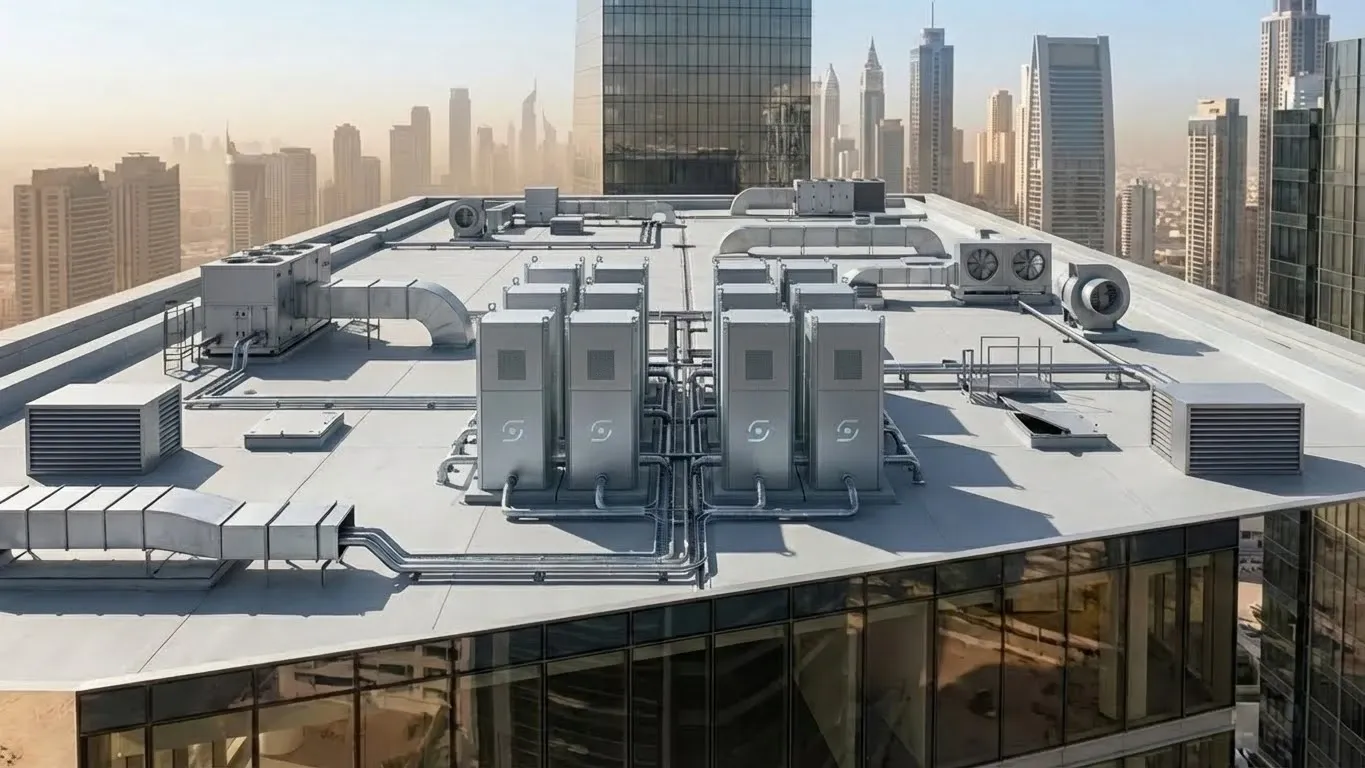
For decades, indoor environmental control has been dominated by HVAC-centered logic. Buildings are designed, commissioned, and operated around heating, cooling, ventilation, and air distribution systems whose primary objectives are thermal comfort, energy efficiency, and regulatory compliance. Indoor air quality (IAQ) has traditionally been treated as a secondary outcome of these systems rather than as an independent, continuously managed engineering domain.
This paradigm is increasingly insufficient, particularly in hot-climate, high-density urban environments such as the United Arab Emirates. In these contexts, indoor air is no longer a passive background condition. It becomes a dynamic system that directly affects energy performance, operational stability, occupant health, cognitive performance, and long-term asset value.
While the industry has significantly improved its ability to measure indoor air parameters, measurement alone does not guarantee control, stability, or performance. The growing gap between monitored indicators and lived indoor experience highlights the limitations of a purely HVAC-driven approach and points toward the need for a broader framework—one that treats air as an actively managed environment rather than a by-product of ventilation.
The Current State of Indoor Air Measurement
Modern buildings typically monitor a defined set of IAQ parameters, widely accepted in international standards and regional guidelines:
Carbon dioxide (CO₂) concentration, commonly used as an indicator of ventilation effectiveness
Fine particulate matter (PM2.5 and PM10), especially relevant in urban and desert-adjacent environments
Volatile organic compounds (VOCs), originating from materials, furnishings, cleaning agents, and equipment
Temperature and relative humidity, closely tied to thermal comfort and microbial risk
Compliance with minimum outdoor air rates as defined by standards such as ASHRAE 62.1
These parameters are measurable, quantifiable, and auditable. They form the basis of indoor air quality assessments in commercial, residential, and institutional buildings across the world, including the UAE.
However, the presence of sensors and dashboards does not automatically translate into a controlled indoor air environment. In practice, many buildings that “meet requirements” still experience air-related complaints, uneven comfort, fatigue, or perceived lack of freshness. This disconnect exists because measurement answers only one question: what is happening at a specific point in time? It does not address how consistently indoor conditions are maintained, how quickly systems respond to change, or how air behaves as a spatial and temporal system.
HVAC Limitations in Hot and Dense Urban Environments
The HVAC paradigm evolved primarily in temperate climates, where increasing outdoor air intake often improved indoor air quality with manageable energy penalties. In hot and arid regions, this assumption breaks down.
In cities such as Dubai and Abu Dhabi, buildings are sealed by necessity. Extreme outdoor temperatures, humidity fluctuations, dust, noise, and air pollution limit the feasibility of natural ventilation. As a result, occupants spend the majority of their time in mechanically conditioned spaces relying on recirculated air.
Increasing outdoor air volumes under these conditions introduces several challenges:
Significant cooling and dehumidification loads, increasing energy consumption
Reduced system stability during peak demand periods
Introduction of polluted or dusty outdoor air into indoor environments
Increased wear on HVAC equipment and filtration systems
Ventilation systems are fundamentally designed to move air. They do not inherently manage the qualitative experience of that air across time, occupancy patterns, and varying external conditions. This distinction becomes critical in dense urban environments where small deviations accumulate into noticeable degradation of indoor conditions.
The Gap Between IAQ Metrics and Real-World Performance
International standards make it clear that IAQ is multi-factorial. CO₂ concentration alone does not define air quality, nor does compliance with minimum ventilation rates ensure stable indoor conditions. Even ASHRAE explicitly recognizes that acceptable IAQ cannot be reduced to a single indicator.
In real operation, buildings face:
Uneven air distribution across zones
Temporal spikes in occupancy that outpace ventilation response
Seasonal drift in humidity and thermal balance
Maintenance variability affecting filtration and airflow
External pollution events such as dust storms or nearby construction
As a result, IAQ performance fluctuates, even when average values appear acceptable. Measurement identifies these fluctuations, but does not inherently correct them. Without a system-level framework for managing air as an environment, buildings remain reactive rather than controlled.
Oxygen: A Missing Variable in Everyday IAQ Management
One of the most notable omissions in mainstream IAQ practice is oxygen concentration as an operational parameter. In most civilian building standards, oxygen is assumed to remain close to ambient atmospheric levels and is therefore rarely monitored outside of safety-critical environments.
Oxygen thresholds are well-defined in occupational health and safety contexts. Concentrations below approximately 19.5% are considered unsafe, while excessive enrichment above defined upper limits introduces fire risk. For this reason, oxygen monitoring traditionally appears only in laboratories, industrial facilities, or spaces where displacement gases are present.
However, in typical residential and commercial buildings, oxygen is neither actively measured nor discussed as part of indoor environmental quality. Instead, the experiential aspects commonly associated with “fresh air”—alertness, reduced fatigue, perceived clarity—are indirectly attributed to CO₂ reduction or ventilation volume.
This creates a conceptual blind spot. While oxygen levels may not frequently fall into dangerous ranges, oxygen is also not treated as a variable that can be intentionally managed to improve the stability and quality of indoor breathing environments, particularly in sealed, air-conditioned buildings.
Why Oxygen Matters in the UAE Context
The UAE presents a unique combination of factors that amplify the relevance of oxygen-aware air management:
Extended time spent indoors due to climate conditions
High reliance on mechanical cooling and recirculated air
Limited natural ventilation in high-rise developments
High-density usage of premium indoor spaces such as offices, hotels, malls, and residences
In such environments, occupants often report symptoms described as “stale air,” “mental fatigue,” or “lack of freshness,” even when standard IAQ parameters are within acceptable limits. These experiences are difficult to address using traditional HVAC controls alone.
Oxygen, while typically stable in outdoor air, becomes part of a broader discussion about indoor environmental quality when buildings operate as closed systems for long durations. Treating oxygen as an invisible constant overlooks its role in shaping the perceived and functional quality of indoor environments.
From Measurement to Environmental Control
The industry’s focus on measurement has delivered valuable transparency, but transparency alone does not produce outcomes. Sensors report conditions; they do not stabilize them. Control requires an operational model that defines targets, acceptable ranges, response strategies, and long-term consistency.
This is the transition point from HVAC-centric thinking to a broader environmental framework.
Rather than viewing air as something that passes through ducts to satisfy code requirements, air must be treated as a managed medium—one that supports human performance, operational efficiency, and resilience under real-world conditions.
Oxyness as an Environmental Management Framework
Oxyness represents a shift from component-based thinking to environment-based control. It does not replace HVAC systems, nor does it redefine established IAQ metrics. Instead, it builds on them by introducing a structured approach to maintaining stable, predictable indoor air environments in hot and dense urban settings.
Within this framework:
IAQ parameters are managed as an integrated system rather than isolated values
External climate and urban pollution are treated as active inputs, not anomalies
Stability over time is prioritized over momentary compliance
Oxygen is recognized as a controllable dimension of the breathing environment within safe, regulated boundaries
By focusing on consistency and control, Oxyness addresses the gap between measured values and lived experience.
Economic and Operational Implications
From an operational perspective, indoor air quality affects far more than comfort. Poorly controlled air environments contribute to higher energy use, maintenance costs, and equipment stress. From a human perspective, air quality influences concentration, decision-making, and productivity.
Research consistently shows that improvements in indoor air conditions correlate with better cognitive performance. In commercial environments, even marginal gains in productivity can outweigh the cost of enhanced air management, given that labor expenses typically exceed energy costs by a wide margin.
For developers and investors, this reframes air quality as a risk management and value preservation issue. Buildings that deliver stable, high-quality indoor environments are more resilient, more attractive to premium tenants, and better aligned with ESG and health-focused expectations.
Beyond Compliance: Air as Infrastructure
Compliance-based IAQ ensures that minimum thresholds are met. It does not ensure that indoor air performs as a reliable environmental system.
In hot and dense cities, air should be treated with the same seriousness as power, water, and thermal systems. It is infrastructure—one that directly shapes how buildings function and how people perform within them.
The transition from HVAC-centered measurement to environment-centered control marks a fundamental evolution in building engineering. Oxyness provides a framework for that transition, translating existing standards into operational reality.
Indoor air is not merely what flows through mechanical systems. It is the environment in which people think, work, recover, and live.
Breathe Better. Live Better. Experience Oxyness.
Sources
World Health Organization – Indoor Air Quality Guidelines
https://www.who.int/teams/environment-climate-change-and-health/air-quality
ASHRAE Standard 62.1 – Ventilation for Acceptable Indoor Air Quality
https://www.ashrae.org/technical-resources/standards-and-guidelines
Dubai Municipality – Technical Guidelines for Indoor Air Quality for Healthy Life
https://www.dm.gov.ae
U.S. Environmental Protection Agency – Indoor Air Quality
https://www.epa.gov/indoor-air-quality-iaq
Harvard T.H. Chan School of Public Health – Indoor Air Quality and Cognitive Performance
https://healthybuildings.hsph.harvard.edu
International Energy Agency – Buildings and Energy Use in Hot Climates
https://www.iea.org/topics/buildings


Module21 for Your Business

Module21 for Your home