
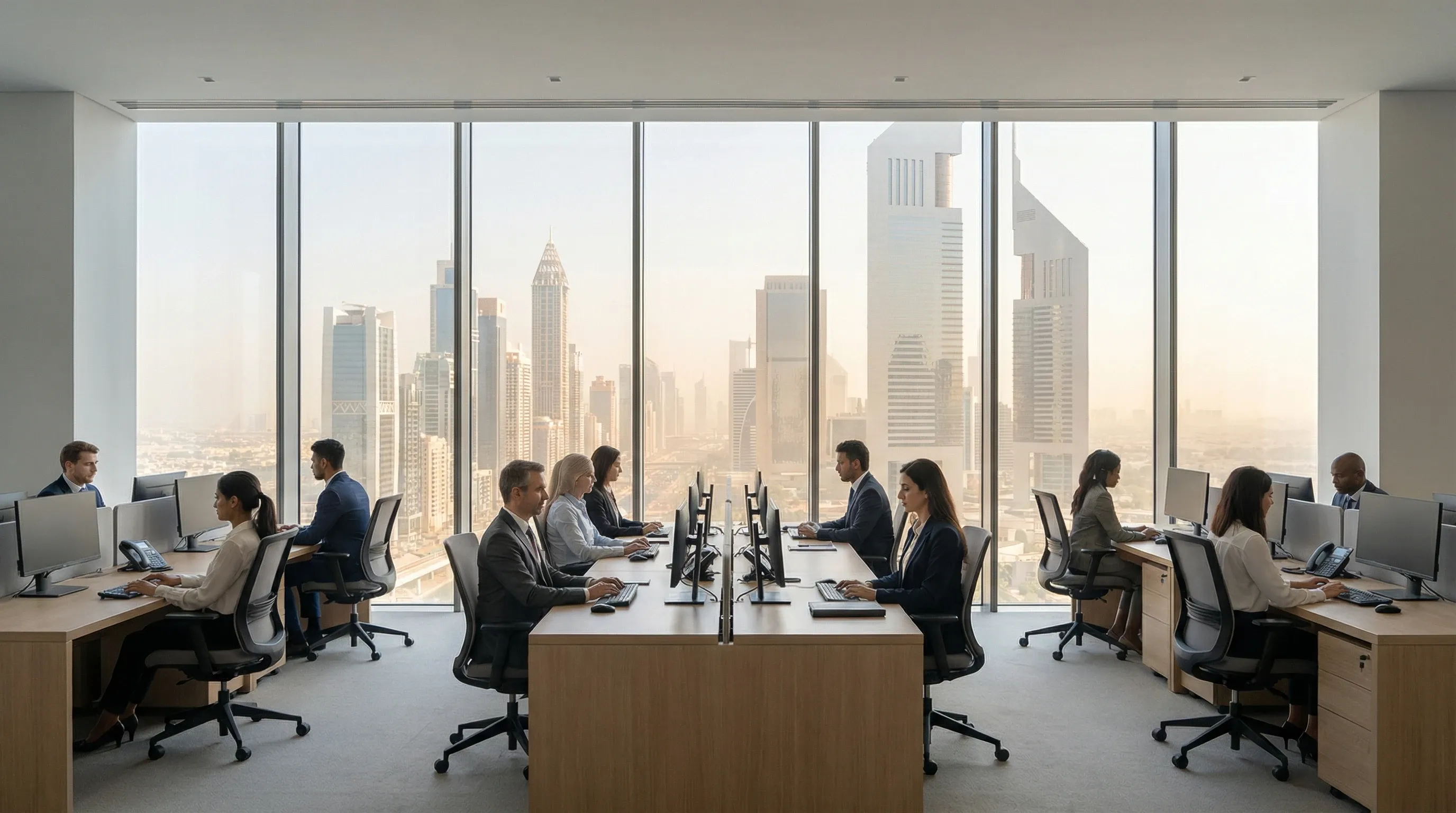
Introduction: The Hidden Layer of Workplace Performance
Modern organizations have learned to measure almost everything. Productivity metrics, engagement scores, financial KPIs, utilization rates, employee turnover, and wellness indicators are now standard components of corporate management. Companies invest heavily in digital tools, office design, flexible work models, leadership development, and employee well-being programs.
Yet despite all this sophistication, one foundational variable remains consistently underestimated: the quality of the indoor environment in which teams operate every day.
This oversight becomes particularly significant in regions with extreme climatic conditions, such as the Gulf Cooperation Council (GCC) countries — including the United Arab Emirates and Dubai. High ambient temperatures, airborne dust, sealed buildings, and continuous reliance on air-conditioning systems create a unique indoor ecosystem. This ecosystem directly affects human physiology and, consequently, cognitive performance, emotional regulation, and team dynamics.
This article examines how indoor environmental quality — and specifically oxygen availability — influences team performance, why conventional HVAC-centered thinking is insufficient, and why oxygen should be treated as a strategic variable for businesses operating in hot-climate regions.
Humans at Work: Biological Systems in Corporate Structures
Regardless of role, seniority, or industry, every employee is fundamentally a biological organism operating within physical constraints. Organizational charts may be abstract, but human performance is governed by physiology.
Oxygen is central to this system. It is essential for:
cellular respiration,
ATP (energy) production,
brain metabolism,
cardiovascular efficiency,
recovery and stress regulation.
Although the brain represents only about 2% of body mass, it consumes approximately 20% of total oxygen intake. Even modest reductions in oxygen availability disproportionately affect cognitive functions, long before any clinical symptoms appear.
In office environments, this does not manifest as acute illness. Instead, it presents as chronic, low-grade performance degradation — difficult to detect, rarely measured, and often misattributed to motivation or organizational issues.
What Happens When Oxygen Availability Declines
In modern offices, the issue is rarely acute hypoxia. The real challenge lies in suboptimal oxygen levels that remain within regulatory norms yet fall below physiological optimality.
When oxygen availability decreases:
Cardiovascular workload increases, as the body compensates to maintain oxygen delivery.
Sympathetic nervous system activity rises, elevating cortisol and stress responses.
Cognitive efficiency declines, particularly executive function and working memory.
Recovery capacity diminishes, even with adequate sleep.
Emotional regulation weakens, increasing irritability and fatigue.
From a business perspective, these physiological effects translate into:
slower decision-making,
reduced focus and attention span,
higher error rates,
increased interpersonal friction,
accelerated burnout.
None of these effects appear suddenly, but collectively they erode team performance over time.
The Gulf Region Context: Climate, Architecture, and Air
Climate as a Structural Constraint
In the Gulf region, outdoor temperatures frequently exceed 40°C (104°F) for extended periods. High humidity and airborne particulate matter further reduce air quality. As a result, modern buildings are designed to be:
highly sealed,
thermally insulated,
fully dependent on mechanical ventilation.
Natural ventilation through open windows is impractical for much of the year. Consequently, indoor air becomes a closed-loop system, shaped almost entirely by engineering decisions.
HVAC Systems: Effective but Incomplete
State-of-the-art HVAC systems excel at:
temperature control,
humidity regulation,
filtration of particulates,
airflow distribution.
However, they are not designed to actively manage oxygen concentration. Their primary objective is thermal comfort and air exchange within regulatory limits, not physiological optimization.
In dense office environments, especially during long workdays, oxygen levels can gradually decline while CO₂ levels rise — without triggering alarms or regulatory violations.
CO₂ Is Measured. Oxygen Is Not.
A critical paradox of modern building management is that carbon dioxide is widely monitored, while oxygen is rarely measured directly.
CO₂ is often used as a proxy for indoor air quality because it correlates with occupancy and ventilation rates. However:
CO₂ does not directly represent oxygen availability,
acceptable CO₂ levels do not guarantee optimal oxygen conditions,
physiological performance depends on oxygen partial pressure, not CO₂ alone.
In hot-climate regions, where fresh air intake is minimized to reduce cooling loads, oxygen levels can remain consistently below optimal atmospheric values (20.9%) while still complying with standards.
This gap between compliance and performance is where hidden productivity losses accumulate.
Cognitive Performance and Decision Quality
Multiple studies demonstrate that indoor air quality directly influences cognitive outcomes. Even moderate deviations from optimal conditions can impair:
strategic thinking,
information processing speed,
problem-solving accuracy,
creativity and complex reasoning.
In office settings, this often appears as:
mental fog in the afternoon,
difficulty sustaining focus,
increased cognitive fatigue under routine workloads.
For knowledge-intensive teams — finance, consulting, engineering, management, and technology — these effects directly impact organizational outcomes.
Emotional Stability, Stress, and Team Dynamics
Physiological strain amplifies emotional responses. When oxygen availability is suboptimal:
stress tolerance decreases,
emotional reactivity increases,
resilience to pressure weakens.
In team environments, this leads to:
higher conflict frequency,
reduced collaboration quality,
lower psychological safety,
leadership fatigue.
Over time, these factors erode organizational culture from within, often without a clearly identifiable cause.
Why This Matters Especially in Dubai
Dubai represents a high-performance business ecosystem:
multinational teams,
fast decision cycles,
competitive markets,
constant operational pressure.
In such environments, even a 5–10% reduction in cognitive efficiency, distributed across teams, compounds into:
slower execution,
reduced innovation,
increased operational risk,
diminished leadership effectiveness.
Ironically, companies often invest heavily in visible initiatives — office aesthetics, wellness branding, engagement platforms — while overlooking the physiological baseline that enables all higher-level performance.
From HVAC Thinking to Environmental Performance Management
The emerging shift in workplace design is not about replacing HVAC systems, but about reframing indoor air as a performance variable rather than a compliance checkbox.
This transition involves:
moving beyond temperature and CO₂ metrics,
understanding physiological thresholds,
treating oxygen as a controllable environmental resource,
aligning building systems with human performance objectives.
In this framework, indoor air becomes an active contributor to productivity, not a passive background condition.
The Business Case for Optimized Air Environments
From an economic standpoint, environmental optimization must justify itself through outcomes. Research indicates that improved indoor air quality can deliver:
8–11% productivity gains,
reduced absenteeism,
lower error rates,
improved retention,
higher engagement scores.
In high-cost labor markets such as Dubai, even marginal performance improvements yield disproportionate returns on investment.
Conclusion
Indoor environmental quality is not a secondary comfort issue. It is a foundational layer of team performance, particularly in regions where climate forces people indoors for most of the year.
In the Gulf region, where sealed buildings and continuous air-conditioning dominate, oxygen availability becomes a critical — yet largely invisible — determinant of cognitive clarity, emotional stability, and organizational effectiveness.
Organizations that evolve from regulatory compliance toward environmental performance management gain a tangible advantage: healthier teams, sharper decisions, and more sustainable productivity.
As the future of work becomes increasingly human-centric, oxygen will no longer be treated as a given — but as a strategic asset.
Sources
Harvard T.H. Chan School of Public Health — Healthy Buildings: Cognitive Function and Indoor Air Quality
Allen, J.G. et al. — Associations of Cognitive Function Scores with Carbon Dioxide, Ventilation, and VOC Exposures, Environmental Health Perspectives
Satish, U. et al. — Is CO₂ an Indoor Pollutant? Direct Effects on Decision-Making Performance, Environmental Health Perspectives
World Health Organization (WHO) — Indoor Air Quality Guidelines
U.S. Environmental Protection Agency (EPA) — Indoor Air Quality and Workplace Productivity
National Institutes of Health (NIH) — Effects of Mild Hypoxia on Cognitive and Motor Performance
ASHRAE — Ventilation for Acceptable Indoor Air Quality (Standard 62.1)
Wargocki, P. & Wyon, D.P. — The Effects of Moderately Raised Classroom Temperatures and CO₂ Levels on Performance
Seppänen, O., Fisk, W. — Some Quantitative Relations Between Indoor Environmental Quality and Work Performance
Zhang, X. et al. — The Impact of Indoor Environmental Quality on Cognitive Performance
OECD — Productivity and Working Conditions in High-Intensity Economies
European Respiratory Journal — Oxygen Availability and Brain Function Under Mild Hypoxic Conditions
Nature Reviews Neuroscience — Brain Energy Metabolism and Oxygen Dependence


Module21 for Your Business

Module21 for Your home